Federal Oversight
The Animal Welfare Act and the Commercial Dog Industry
What This Page Covers
This page provides a simplified overview of the Animal Welfare Act (AWA), including the history of the law and the key terms and definitions needed to better understand USDA records and inspection reports. Learn how the puppy pipeline operates, the different roles people play within the commercial dog industry, and why understanding licensing and oversight matters.
This section also explains the minimum standards of care required under the AWA, what it means when a USDA license is active, suspended, or canceled, and what can happen when violations are found during inspections.
You can find free printables to download for your research and links to help you in your journey to responsible pet ownership. You’ll also find links to all of the resources at the bottom of the page with some frequently asked questions.
History of the Animal Welfare Act
Blue Book
Key Terms & Definitions
This guide condenses the key information from the 352-page book into an easier-to-understand format.
Grey Book
Regulated Business Definitions
This guide condenses the key information from the 20-page book into an easier-to-understand format.

Understanding the Puppy Supply Chain
Beneath the surface of the puppy industry lies a network of USDA-licensed breeders and brokers responsible for producing and distributing thousands of puppies each year. While federally regulated, this system prioritizes volume and commerce, often at the expense of animal welfare.
Class A: Breeder
The entire business consists only of animals that are bred and raised on the premises in a closed or stable colony. Those animals are acquired for the sole purpose of maintaining or enhancing the breeding colony.

Class B: Dealer/Broker
Dealer and broker are interchangeable terms in the puppy buying industry. They are the middlemen who purchase puppies from breeders and resell them to others. They rarely house animals themselves but coordinate transport.

Class D: Intermediate Handler
Any person or government agency that is engaged in any business in which the person receives custody of animals in connection with the animal’s transportation in commerce.

Class E: Carrier
The operator of any airline, railroad, motor carrier, shipping line, or other enterprise that is engaged in the business of transporting any animals for hire.

USDA Minimum Standards of Care
By law, the federal government sets a minimum standard of care for animals in commercial dog kennels. This section breaks down what the law states and the reality of its application.
Commercial dog breeders operate under the same principles as farmers. A farmer’s annual income depends on how much livestock they can raise and sell to consumers. Like livestock producers, breeders are inspected by the USDA, regulated under the AWA, and focused on maximizing the number of animals they can sell for profit. However, the AWA sets only minimal standards of care, just enough to keep animals alive, not necessarily healthy or well-treated. Therefore, a breeder must lower their overhead expenses and maximize the number of puppies each female dog can produce to generate income and profit from their investment.
Exercise
- Dogs housed individually: Dogs over 12 weeks of age, except bitches with litters, housed, held, or maintained by any dealer, exhibitor, or research facility, including federal research facilities, must be provided the opportunity for exercise regularly if they are kept individually in cages, pens, or runs that provide less than two times the required floor space for that dog.
- Dogs housed in groups: Dogs over 12 weeks of age housed, held, or maintained in groups by any dealer, exhibitor, or research facility, including federal research facilities, do not require additional opportunity for exercise regularly if they are maintained in cages, pens, or runs that provide in total at least 100 percent of the required space for each dog if maintained separately.
- The opportunity for exercise may be provided in several ways, such as:
- Group housing in cages, pens or runs that provide at least 100 percent of the required space for each dog if maintained separately under the minimum floor space requirements from above.
- Maintaining individually housed dogs in cages, pens, or runs that provide at least twice the minimum floor space from requirements above.
- Providing access to a run or open area at the frequency and duration prescribed by the attending veterinarian, or other similar activities.
Translation:
- One dog can spend its entire life in a crate that is only twice the size of the dog itself, without anyone ever having to even open the door to the crate except to feed it and give it water.
- More than one dog can be kept in a crate that is minimum twice the size of each individual dog within that crate. No veterinary exercise requirements because the dogs can run around together for exercise.
Both of these options comply with federal regulations and are completely legal.
Temperature
Indoor housing facilities:
- When dogs or cats are present, the ambient temperature in the facility must not fall below 50 °F for dogs and cats not acclimated to lower temperatures, for those breeds that cannot tolerate lower temperatures without stress or discomfort (such as short-haired breeds), and for sick, aged, young, or infirm dogs and cats, except as approved by the attending veterinarian. Dry bedding, solid resting boards, or other methods of conserving body heat must be provided when temperatures are below 50 °F. The ambient temperature must not fall below 45 °F for more than 4 consecutive hours when dogs or cats are present, and must not rise above 85 °F for more than 4 consecutive hours when dogs or cats are present. Ventilation must be provided by windows, vents, fans, or air conditioning. Auxiliary ventilation, such as fans, blowers, or air conditioning must be provided when the ambient temperature is 85°F or higher. The relative humidity must be maintained at a level that ensures the health and well-being of the dogs or cats housed therein, in accordance with the directions of the attending veterinarian and generally accepted professional and husbandry practices.
Translation: If the temperature dips below 45 degrees, the kennel is following regulations, as long as it’s under 4 hours that the dogs are exposed to the conditions. If the temperature goes above 85 degrees, the breeder must turn on a fan. A dog living in these conditions to become a companion animal should consume a high-end diet with the option to escape the extreme temperatures. Without providing an escape and proper nutrition, the dog can develop behavioral issues from stress.
Food
Dogs and cats must be fed at least once each day, except as otherwise might be required to provide adequate veterinary care. The food must be uncontaminated, wholesome, palatable, and of sufficient quantity and nutritive value to maintain the normal condition and weight of the animal. The diet must be appropriate for the individual animal’s age and condition.
Translation: The AWA doesn’t specify food that is wholesome and has nutritional value. Therefore, any dry kibble that can be bought in bulk can be fed to the dogs once a day, based on the bare minimum needed to sustain life. This does not take into consideration that different breeds have different nutritional needs.
Water
Potable water must be continuously available to the dogs, unless restricted by the attending veterinarian.
Translation: Breeders only need to offer the dogs water twice a day (regardless of temperature) for one hour each time. When a breeder has 200 dogs on site, how does this need get met? They can use PVC pipes that drip water into the cage for the dog to drink from a spout similar to how a gerbil obtains its water. The anatomy of a dog does not allow it to coat its tongue and drink like it was designed to do, which could lead to dehydration.
Flooring
Primary enclosures equipped with mesh or wire floors shall be so constructed as to allow feces to pass through the spaces of the mesh or wire. Provided, however, that such floors shall be constructed to protect the animals’ feet and legs from injury.
Translation: Commercial kennels can stack the crates so that the feces falls to the dog below and eventually to the floor. This allows for the busy breeder to hose the feces and urine from the floor while still following the AWA standards.
Breeding
There are no limitations on how many times a dog can be bred in one year or for the duration of her lifetime.
Translation: Dogs can breed:
- Until they die
- Until the owner surrenders, throws them away, or kills them
- Until the owner retires them as pets
Cage Size
The AWA uses a formula to calculate a kennel size for a dog. The minimum space requirement for a single dog is 6 inches longer than the dog itself and 6 inches taller than the dog’s full height when standing.
Translation: The dog can spend its entire life in a crate that is just big enough for them to turn around and lie back down.
Staff:Puppy Ratio
Under the AWA, there is no staff to puppy ratio for commercial breeders. A lot of commercial breeders set up PVC pipes for water, feed them once a day and hose the crates down. There are no standards listed under the AWA for socialization.
Translation: Your puppy may come from a facility that has hundreds of puppies and only a handful of staff. There are no laws regulating how many need to be on staff to care for puppies and their mothers.
*Most puppies in pet stores and online sites come from commercial breeders.
Click here to find more on animal welfare regulations:
📗 To go deeper into the world of commercial dog breeding, Fetch the Facts recommends the book:
Step-by-Step Guide to Buying a Puppy Responsibly
Always consider adoption first. But if you choose to buy a puppy, please follow these quick steps.
Step 1
Learn what it means to be licensed vs. registered
Learning how to research licensed and registered breeders, kennels, rescues, and sellers can help consumers better understand how an operation is regulated and what public records or inspection information may be available.
Start here ⬇️
If the puppy comes from a USDA licensed or registered person, the puppy’s paperwork will include a USDA license or registration number, which consists of a combination of letters and numbers in this format: XX-X-XXXX.
(The middle (x) will contain a letter to indicate the license or registration class.)

| Feature | USDA Licensed Individual | USDA Registered Individual |
|---|---|---|
| Activities | Engages in regulated activities for compensation or profit, such as buying, selling, or brokering animals for research, exhibition, or as pets. | Owns or operates a research facility, is a carrier, or is an intermediate handler of animals. |
| Fee | Pays the USDA a fee | Does not pay the USDA a fee |
| Purpose | To regulate for-profit animal businesses to ensure humane treatment. | To regulate non-profit facilities and handlers to ensure humane treatment. |
| Example | A dog breeder selling puppies to a pet store or a pet broker selling dogs to a research institution. | A university that uses animals for research, a company that transports animals, or a facility that handles animals for research. |
Step 2
Learn who is exempt and why
Some unlicensed breeders (see below for examples) can still legally sell animals. While a license can provide a layer of accountability, it doesn’t guarantee humane treatment. Likewise, an exemption doesn’t automatically mean animals are being mistreated. Sometimes these exemptions can be legal loopholes.
*Check your state’s laws to see if they provide oversight where federal regulations fall short.
Who: Hobby Breeders
Breeders with 4 or fewer breeding females
Why: If they only sell offspring born and raised on their premises, and only in-person, they’re considered “retail pet stores” and exempt.
Advocacy Concerns:
- These breeders sell without USDA inspections. There is no federal tracking of how many animals they produce unless the specific state law says otherwise.
- Pet stores/online sellers can legally source from hobby breeders with no oversight and no obligation to tell the customer, unless their state law says otherwise.
- Even when a state requires disclosure, the breeder might claim hobby status to avoid licensing, and that can make enforcement difficult.
- Allows puppy mills to disguise themselves as small breeders or use unlicensed middlemen.
Who: Retail Pet Sellers (Face-to-Face Sales Only)
Individuals or facilities that only sell pets in person, directly to the buyer
Why: Considered “retail pet stores” under the AWA and not regulated by the USDA, regardless of how many animals they sell. But if they own 4+ breeding females, they must be licensed.
Advocacy Concerns:
- Exemption covers in-person farm or home sales, but allows loopholes in enforcement when sellers falsely claim face-to-face sales to avoid licensing.
- Some states have laws that require the pet store to disclose the USDA license number and/or the breeder’s name and address.
- If the state doesn’t have its own laws regarding retail pet stores, then there is no oversight or regulation protecting the animals.
Who: Transport only Broker
Coordinates logistics (e.g., hires a transport company or schedules shipments)
Why: Because they never physically handle the animals, they fall outside USDA licensing requirements as a “dealer.”
Advocacy Concerns:
- Some states have laws that require more transparency to find the connections between the breeder and the consumer. Check your state laws.
- It is hard to trace how many other people and animals the dog came in contact with between the breeder and consumer.
- Puppy mills may use unregulated brokers to avoid being directly linked to pet stores.
Who: Private Rescues and Shelters
Non-government, non-commercial animal shelters and rescues
Why: If they do not breed or sell for profit. The AWA does not regulate non-commercial rescue activities.
Advocacy Concerns:
- Some states have laws that require shelters and rescues to be licensed. Check your state laws.
- Most people don’t check the status of the nonprofit on the IRS website or look at the 990’s for red flags. More on that here.
- Some rescues state that they are “pulling dogs from [insert state]” but could be buying from breeders to sell for profit.
Bottom Line:
Does the seller have a lot of puppies listed under a hobby breeder? If so, why? Ask the seller for the breeder’s name and address so you can visit their property (not meet at a separate location). Ethical breeders and sellers have nothing to hide so they won’t try and dodge questions and visits.
Step 3
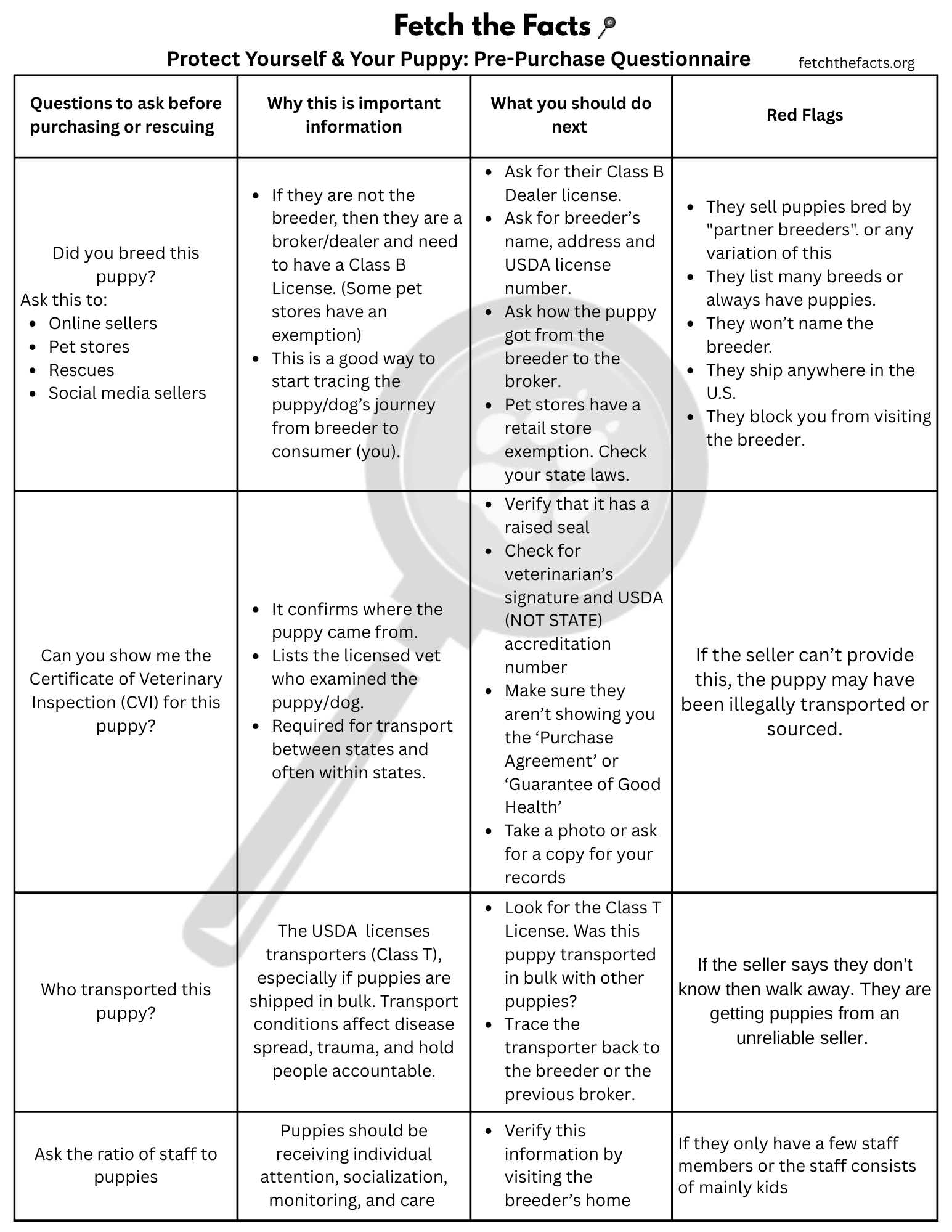
Ask questions
A responsible seller doesn’t just answer your questions; they expect them. If someone avoids or resents your curiosity, they may be hiding something. Let transparency guide your decision.
Step 4
Learn how to read the spreadsheet and inspection reports
Don’t stop at what you’re told. Use the answers you’ve collected to research the breeder or rescue’s inspection reports, confirm their claims, and see the conditions with your own eyes.
Start here ⬇️
Click on ‘List of Persons Licensed or Registered Under the Animal Welfare Act (AWA)’ to find the excel spreadsheet.
Search by the license number (XX-X-XXXX), name or city/state. This is just a list of individuals licensed or registered. The important part is checking their inspection reports to see if they have violations.
Unsure of how to read this spreadsheet? Follow these directions. ➡️

How to Read the Spreadsheet
Registration Type: This column is the class type that a person is licensed or registered under. See ‘Class Type Definitions’ from Step 1.
APHIS Registration Number: This is the XX-X-XXXX format. See photo below.
Account Name: The legal name of the person or entity who holds the USDA license.
- Used in official contracts and enforcement actions
- Appears on legal documents
- Stays consistent even if the business name changes
DBA (Doing Business As): The public-facing name a person or business uses. This is what customers might see on websites, shipping paperwork, kennel signs, or pet store tags.
- Can differ from the legal name
- May be used to mask identity (e.g., “Happy Tails Puppies” instead of “Smith Breeding LLC”)
- One entity can have multiple DBAs tied to a single USDA license
City/State
Expiration Date: Some of the expiration dates are the year 3000. That is only for Excel formatting purposes. They are still required to file paperwork.
💡To narrow your search, click on the arrow at the top of the column and type your search term.
Read the Inspection reports
a. Type the license number into the Public Search Tool. If the USDA license number is unavailable, request the name and address instead.
b. Verify that the status of the certificate (aka license) is active. If it’s canceled and they’re still selling puppies, that’s a red flag.
c. Click “Query Inspection Reports”.
d. Look through all of the reports for any violations.
Visit the breeder and ask questions BEFORE you purchase
It’s ok to walk away. Unethical sellers count on your emotions to drive the sale and often hide behind legal loopholes. They may be following the law, but that doesn’t mean they’re doing the right thing. They want you to feel sorry enough to buy the puppy, convincing yourself you’re “saving” it.
Buying that dog only fuels the cycle. It puts money in the seller’s pocket and ensures more animals will suffer.
If something feels off, speak up
If the conditions don’t meet your expectations, trust your instincts. Not everyone in the puppy industry is intentionally irresponsible; some simply lack the proper education or oversight. That’s why regulations exist. If you have concerns, report them through the appropriate channels.
Click below to file a complaint with APHIS and check your state laws.
Certificate Status
Active or Canceled
&
What This Means
A spotless USDA report doesn’t guarantee humane treatment; it just means the facility met the lowest standards required by law. Learn what it means if the status is active or canceled.
Active
Active without violations: The standards that breeders must meet to be licensed under AWA are set to a minimum. Passing the inspections doesn’t mean animals are treated humanely. It means the inspector determined that they are meeting the standards set under the federal law.
Active with violations: This will have to be a personal decision as to whether you want to purchase this puppy from a breeder who has violations. Violations are given when the minimum standards of care are not met.
🛑 NEVER purchase a puppy to “save it.” Your money will continue to fuel the cycle of cruelty. If you think the breeder should be reported, you can file a complaint here. Then reach out to a local rescue or shelter for guidance on what to do next.
Canceled
The breeder is no longer authorized to breed and sell animals commercially under the AWA. This could be for a variety of reasons. However, it’s important to find out why they’re still selling puppies, and if it’s legal.
______________
Voluntary: The breeder may have chosen not to operate anymore.
Failure to renew: Licenses must be renewed annually.
Failed Inspection: Pre-inspection or routine inspection wasn’t passed
Chronic or critical violations: (e.g., neglect, untreated illness, repeated noncompliance).
Failure to comply: after written warnings or a formal hearing.
Consent agreements: A breeder agrees to give up their license to avoid court or fines
Hint: Search the breeder’s inspection reports by last name or city to see if they opened up under a new name.
Bottom Line: A “cancelled” license doesn’t always mean cruelty, but it can signal serious problems. It’s important to research whether it was voluntary, due to business closure, or part of a pattern of violations. Sometimes breeders close and then open under a new name (DBA). This can be a red flag. Remember that a license ≠ a good or a bad breeder. However, if they are operating with a canceled license but still selling puppies, you should find out why.
You can also access APHIS’ Official Warnings-Notice of Alleged Violation, Settlement Agreements, Administrative Complaints, and Decisions and Orders from the Office of the Administrative Law Judges and the Office of the Judicial Officer. Click the AWA Actions button below.
Types of Violations and What Happens Next
The enforcement process for breeders, brokers, and carriers who break the Animal Welfare Act.
NonCritical NCI: an issue in which the inspector should determine if it should be cited on the inspection report or determine if a verbal warning should be given without noting it on the inspection report. Any issue that does not rise to the level of an NCI is in compliance.
Direct NCI (Non-Compliance Item): is a violation that is currently having a serious or severe adverse effect on an animal’s welfare, or has a high potential to do so in the immediate future (e.g., an animal with an untreated broken leg).
Critical NCI: a broader category that includes all direct NCIs, as well as other non-compliance issues that resulted in serious, adverse impacts on animal welfare, even if the impact occurred outside of the immediate inspection process.
Teachable Moments: As of 7/28/22, Congress directed the agency to no longer use this language due to the dramatic decrease in violations in 2018 when it was implemented compared to previous years.
Important Note
An October 2025 report from the Animal Welfare Institute shows that the government is issuing far fewer penalties for AWA violations especially after SEC v. Jarkesy.
In a Nutshell
Since June 2024, USDA-APHIS’s issuance of fines against AWA violators has hit its lowest point since early 2020 with the majority of actions having shifted away from enforcement and toward the issuance of mere warnings. (page 13)
Why is this concerning for puppies?
Some advocates and legal analysts believe the ruling may have weakened AWA enforcement which is why the numbers are so low for violations.
Why is this concerning for consumers?
This could appear as less violations. But the reality it may be due to only issuing warnings over official violations.
What can we do?
Speak up about accountability. Ask whether warnings alone are enough when animals are harmed, and what real consequences should exist for repeat violators.
Take Action
Contact your local and state legislators to advocate for stronger animal welfare laws, increased breeder oversight, and better protections for dogs and puppies. Public voices and community involvement play a critical role in creating meaningful change and improving animal care standards.
Federal Legislatures
Find Your State Legislatures
Key Violation Differences
| Feature | Direct NCI | Critical NCI |
|---|---|---|
| Timing of Harm | The serious harm is occurring at the time of inspection or is imminent. | The serious harm has occurred, or is occurring, and the scope includes violations that may have happened prior to the inspection. |
| Scope | Limited to non-compliance actively posing an immediate threat to an animal’s well-being. | A broader designation that encompasses all direct NCIs plus other severe violations like refusing an inspection, falsifying records, or operating with a suspended license. |
| Example | An animal found with an untreated injury. | Falsified veterinary records, which led to adverse animal welfare outcomes. |
| Consequence | May result in more frequent inspections and enforcement actions. | May also result in more frequent inspections and enforcement actions, often more severe due to the nature of the violation. |
For a list of examples of violations, visit the Animal Welfare Inspection Guide. The explanation and examples start on page 327.
What Happens After a Violation?
- Official Warning
- A formal notice that the breeder violated the law.
- No fine or penalty, just a warning to improve.
- Common for first-time or “minor” violations.
2. Fines (Civil Penalties)
- Breeders can be fined up to $10,000 per violation
- Fines are often negotiated down or waived entirely.
- Many repeat violators operate for years without paying significant penalties.
3. License Suspension or Revocation
- The USDA can suspend or revoke a license, but this is rare.
- Often only pursued after years of repeated violations.
- Some breeders surrender their license voluntarily to avoid revocation, then reapply later or have a family member apply instead.
4. Cease and Desist Orders
- Issued by USDA or an administrative law judge.
- Commands the breeder to stop certain practices or operations.
- Violating the order can lead to further penalties, but again, enforcement is weak
5. Criminal Chargers (Rare)
- In extreme cruelty cases, the Department of Justice may pursue criminal charges.
- However, most violations, even severe ones, are handled administratively, not criminally.
Each state in the United States has enacted statutes to punish individuals who engage in cruelty to animals. Click the button below to find your state’s statutes compiled by the National Agricultural Law Center.
Latest USDA Office of Inspector General Report
OIG assessed whether dog breeders corrected previous noncompliances and whether APHIS carried out enforcement actions for substantiated AWA violations. The information below is from the most current report dated February 3, 2025.
Objective:
- Determine whether selected dog breeders corrected AWA noncompliances previously identified by the agency.
- Determine whether the agency carried out enforcement actions on dog breeders with substantiated AWA violations during the scope period.
Process:
- Reviewed activities for dog breeders over the course of [redacted].
- Reviewed applicable laws and regulations.
- Reviewed APHIS AC policies, procedures and inspection reports.
- Accompanied APHIS inspectors to dog breeder facilities and reviewed APHIS’ enforcement actions on substantiated AWA violations
Recommendations:
- APHIS needs to strengthen its inspection process to ensure inspection due dates are properly calculated.
- APHIS needs to provide additional training on dog breeder inspections and ensure consistency.
- APHIS needs to establish a process to ensure complaints are closed timely.
- APHIS needs to perform a risk assessment of the complaint process.
Statistics from this report:
- 80% of dog breeders visited had not fully corrected AWA noncompliances.
- APHIS did not address complaints in a timely manner.
- APHIS’ inconsistent and untimely inspections may have also contributed to the dog breeders’ continued violation of AWA requirements
- Determined that continued noncompliance with AWA requirements poses a threat to the safety and well-being of the animals.
- OIG determined that APHIS followed its process for carrying out enforcement actions for breeders with substantiated AWA violations.
In a Nutshell
The government’s system for inspecting commercial dog breeders is not working well enough to protect dogs. Inspectors often missed inspections, handled complaints slowly, and many breeders continued violating the Animal Welfare Act without fixing problems.
→ You can find the full report here.
Research Corner
Need help researching?
The goal of this site is to put all of the information in one place and make it free to the public but we know researching a puppy seller, breeder, rescue, or shelter takes time and sorting through public records, inspection reports, and licensing information can be overwhelming. Fetch the Facts offers consumer research services to help make the process easier. Whether you’re looking to support a responsible breeder or want to learn more about a rescue or shelter before adopting, we’re here to help.
Fetch the Facts does not promote or discourage a consumer’s choice to select a specific dog breed, but encourages informed and responsible decisions regardless of where a dog comes from. We believe that supporting responsible breeding practices, ethical rescues, and informed pet ownership can help improve animal welfare and reduce the number of dogs entering shelters over time.
If you are interested in this service please choose from one of the options below:
Puppy Trace Report
This report traces the puppy’s path from its current seller back to the breeder using publicly available records available under federal and applicable state laws. Depending on what information is publicly available, the report may include:
- The seller’s license number
- Seller inspection reports
- The breeder’s and/or broker’s license number
- Breeder and/or broker inspection reports
- Previous business names or aliases associated with the breeder, broker, or seller
- Copies of inspections or enforcement reports
- The transporter’s USDA registration number and any publicly available transporter violations or enforcement records.
This report is based solely on publicly available information and record availability may vary by state, agency and seller.
Not sure how many reports you need?
Review the examples below before submitting your request. Puppies from the same litter and seller can often be researched together, while puppies from different litters or sellers require separate research reports.


Shelter/Rescue Transparency Report
This report reviews a rescue or shelter using publicly available records and information available under federal, state, and local laws (when applicable). Depending on what information is publicly available, the report may include:
- The organization’s registered business or nonprofit name
- State charity or nonprofit registration information
- USDA and/or state license information (if applicable)
- Inspection reports and publicly available violations
- Previous business names, aliases, or affiliated organizations
- Consumer complaints
- Enforcement actions, or legal cases that are publicly documented
This report is based solely on publicly available information and record availability may vary by state, agency, and organization type.
Frequently Asked Questions
➡️ Where can I find a list of licensed and registered individuals?
Click on the USDA Public Search Tool. Follow Step 4 from above.
1.) Search List of persons licensed or registered under the Animal Welfare Act (AWA) to verify they have a license.
2.) Click on Inspection reports to see if the person has any violations.
3.) Click on Animal Welfare Warnings and Enforcement Actions to verify they do not have past or present enforcement actions.
➡️ What is the difference between someone who is licensed and someone who is registered?
Under the AWA, “licensed” and “registered” are not interchangeable. They refer to different types of regulation and oversight.
Licensed
- Breeders who sell wholesale (to pet stores, brokers, or online sight-unseen buyers) and have 4+ breeding females.
- Animal dealers (brokers who buy and resell animals).
- Exhibitors (circuses, zoos, petting farms, etc.)
What this means:
- Must apply for and maintain a USDA license.
- Must pass a pre-license inspection and ongoing inspections.
- Pay annual licensing fees based on revenue/animal count.
Key Point: A license means you’re in the business of selling, breeding, or exhibiting animals in a way regulated by the AWA
Registered
- Research facilities (universities, private labs, hospitals using animals in research, teaching, or testing).
- Carriers and intermediate handlers (airlines, transport companies, shipping agents moving regulated animals)
What this means:
- File a registration with the USDA rather than getting a license.
- Still subject to inspections, but the requirements differ from licensed breeders/dealers.
- No pre-license inspection for some registrants. They register, then USDA oversight begins.
Key Point: Registration is for entities that handle or use animals in regulated ways but aren’t selling/breeding them commercially.
➡️ Why would it be important to know who transported my puppy?
The USDA requires anyone commercially transporting puppies, particularly across state lines, to be registered, not licensed. While USDA registration does involve inspections, they are typically less frequent than those for licensed breeders.
To maximize profit, transporters often carry high volumes of puppies from multiple kennels in a single vehicle. If not done properly or by an individual not educated in transporting puppies, the risk of disease transmission increases, especially in crowded conditions where puppies from different environments are mixed together.
If a puppy is transported by someone not properly registered with the USDA, it becomes extremely difficult to trace the dog back to its breeder of origin. Without this traceability, diagnosing the source of an illness can be nearly impossible, leading to higher veterinary bills and greater financial risk for you, the consumer
➡️ How can I verify if the breeder is licensed or a “hobby breeder”?
The term “hobby breeder” isn’t a legal definition. If you are unable to find whether the person is licensed using the USDA Public Search Tool, you’ll have to do a little independent detective work.
Ask direct questions. A real hobby breeder should answer clearly and without hesitation.
- How many breeding dogs do you own?
- How many litters do you have per year?
- Do you sell to pet stores, brokers, or online without meeting buyers first?
- Do you have a USDA license? (If yes, they are not a hobby breeder under USDA rules.)
➡️ Can I look up the inspection report while at the pet store or seller’s business before I purchase my puppy?
Absolutely!! Bailing Out Benji’s Licensed Breeder/Broker Search Engine is free and accessible to everyone! They have made it easy to search and find the inspection report immediately. Click below and type in the USDA license number or the breeder/broker’s name.
➡️ Where can I find information on my state laws?
Here are two sites that can help you look up your state laws. Humane World for Animals has an organized spreadsheet of just about every law related to animals throughout the country. The National Agriculture Law Center lists the statutes in each state for animal cruelty.
➡️ Is the “Puppy Lemon Law” covered in all states?
No. As of 2023, only 22 states have pet purchaser protection acts.


